Shoplifting Defense From a
Former Pima County Judge
Shoplifting cases frequently turn on details.
What did store employees actually observe? Was merchandise concealed? Was an item overlooked during checkout? What happened at a self-checkout register? Was there evidence of an intent to pay? What does surveillance video show? Were there multiple people involved? What statements were allegedly made after detention?
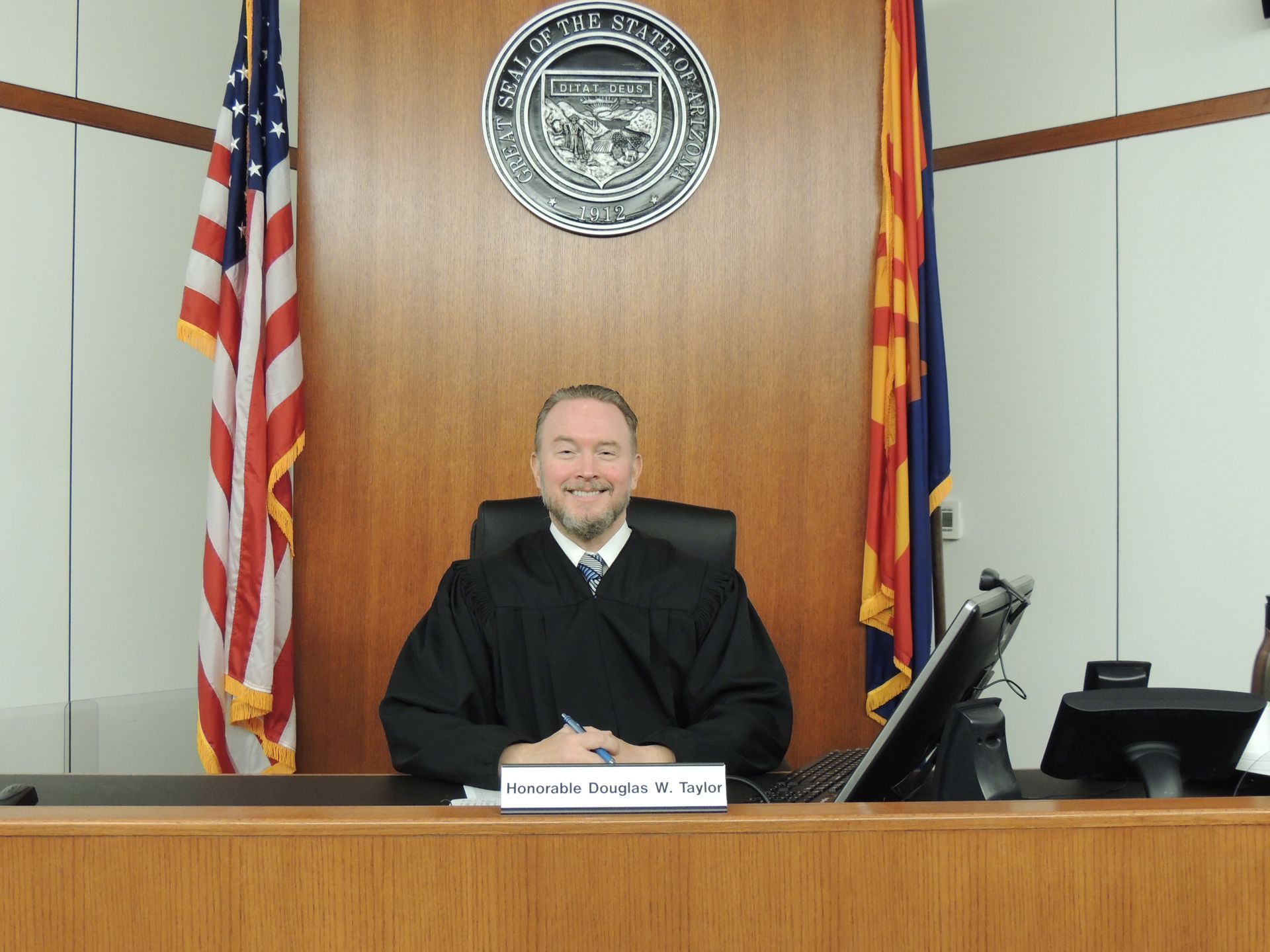
Before returning to criminal defense practice, Douglas W. Taylor served as an elected Pima County Judge. That experience provides a perspective developed from years of evaluating evidence, witness credibility, criminal allegations, and legal arguments from the bench.
A shoplifting charge should be analyzed based upon
what the evidence actually proves, not merely what a loss-prevention report or police report alleges.
What Does Arizona Consider
Shoplifting?
Arizona's shoplifting statute covers more conduct than simply walking out of a store with unpaid merchandise.
Under
A.R.S. § 13-1805, prosecutors may allege shoplifting when a person knowingly obtains merchandise with intent to deprive through conduct including:
- Removing merchandise without paying the purchase price
- Charging merchandise to a fictitious or unauthorized person
- Paying less through certain tricks or artifices, including altering or substituting a price tag or marking
- Transferring merchandise from one container to another
- Concealing merchandise
Arizona law also contains presumptions relating to knowingly concealing unpurchased merchandise and using certain devices or articles to facilitate shoplifting.
The precise allegation matters. A concealment case may present very different evidence from a self-checkout, price-switching, or alleged organized-retail-theft case.
Intent
Can Be the Central Issue
Shoplifting requires an
intent to deprive.
That makes the accused person's intent an important issue in many cases.
Retail transactions are not always simple. People become distracted. Items can remain underneath a shopping cart. Self-checkout machines malfunction or fail to scan merchandise. Customers may mistakenly scan the wrong barcode, believe an item registered when it did not, or leave a checkout area without realizing something remained unpaid.
None of those possibilities automatically establishes a defense. But an unpaid item does not eliminate the State's obligation to prove the mental state required by the statute.
Surveillance footage, receipts, payment records, witness observations, the accused person's conduct, statements, and the surrounding circumstances may all become relevant to determining what actually occurred.
Store
Surveillance
and Loss-Prevention Evidence
Retail shoplifting cases frequently depend heavily upon store surveillance and the observations of loss-prevention personnel.
That evidence should be examined carefully.
Important questions may include:
- Where did surveillance begin?
- Does video capture the entire incident or only portions of it?
- What happened before the alleged concealment?
- Can the merchandise and accused person actually be identified?
- Does the video show conduct consistent with an intent to steal?
- What occurred at checkout?
- Are receipts or transaction records available?
- Were other people shopping with the accused?
- Do written loss-prevention reports accurately describe what the video actually shows?
A report is somebody's description of the evidence.
The evidence itself can tell a different story.
REAL CLIENTS. REAL RESULTS.
RECENT SHOPLIFTING WINS:
8/26/2026 — Client “R.B.” — 5 Counts Shoplifting, 4 Counts Trespassing —
ALL DISMISSED!
8/19/2026 — Client “J.R.” — Shoplifting, False Reporting —
DISMISSED!
7/29/2026 — Client “A.M.” — Shoplifting —
DISMISSED!
7/23/2026 — Client “E.C.” — Shoplifting, Failure to Appear —
DISMISSED!
7/20/2026 — Client “D.N.” — Shoplifting —
DISMISSED!
7/20/2026 — Client “K.S.” — Shoplifting —
DISMISSED!
7/15/2026 — Client “V.O.” — Shoplifting and Imperial Minor by Neglect —
DISMISSED AT TRIAL!
Case results depend on the unique facts and law of each matter. Prior outcomes do not guarantee or predict a similar result.
Misdemeanor
vs. Felony Shoplifting in Arizona
The value of the merchandise and other circumstances can determine whether an Arizona shoplifting charge is prosecuted as a
misdemeanor
or
felony.
Under the currently published version of
A.R.S. § 13-1805:
- Property valued at
less than $1,000 is generally a
Class 1 misdemeanor
- Property valued at
$1,000 or more but less than $2,000 is a
Class 6 felony
- Property valued at
$2,000 or more is a
Class 5 felony
- Shoplifting a
firearm valued below $1,000 is nevertheless a
Class 6 felony
The statute also provides felony treatment in certain circumstances involving a continuing criminal episode, criminal street gangs or syndicates, specified facilitating devices or articles, and certain qualifying prior offenses.
Because classification can depend upon more than the price of a single item, the precise allegations and applicable subsection should be examined carefully.
When Shoplifting Can Become a Class 4
Felony
Arizona law provides particularly serious treatment for certain shoplifting allegations.
A.R.S. § 13-1805 provides for a
Class 4 felony when a person, in the course of shoplifting, uses an artifice, instrument, container, device, or other article with the intent to facilitate shoplifting. The statute also provides Class 4 felony treatment when a person commits shoplifting after having previously committed or been convicted within the preceding five years of two or more specified offenses involving burglary, shoplifting, robbery, organized retail theft, or theft.
That means a seemingly ordinary retail accusation can become substantially more serious depending upon the alleged method and criminal history.
Self-Checkout Shoplifting Allegations
Self-checkout technology has created a distinctive category of retail-theft investigations.
Stores may allege that merchandise was intentionally not scanned, that an incorrect barcode was used, that an item was scanned as a less expensive product, or that merchandise passed through checkout without payment.
But the existence of a checkout discrepancy does not by itself answer the critical question of
intent.
Video, transaction records, scanner data, receipts, the sequence of events, other successfully purchased merchandise, and the accused person's behavior can all matter when distinguishing intentional conduct from mistake or technological error.
Concealment
and Arizona Shoplifting Law
Concealment
deserves particular attention because Arizona's statute expressly addresses it.
The law provides a presumption concerning the required mental state when a person knowingly conceals unpurchased merchandise on themselves or another person while inside the establishment.
That does not mean the defense should simply accept the store's characterization of what occurred.
The circumstances surrounding the alleged concealment, surveillance footage, witness observations, handling of the merchandise, and other evidence should still be examined carefully.
Merchant and Loss-Prevention
Detention
Arizona law permits a merchant, employee, or agent with
reasonable cause to detain a suspected shoplifter on the premises in a reasonable manner and for a reasonable period for questioning or summoning law enforcement.
That does not make every detention or every accusation correct.
What store personnel observed, why they initiated the detention, what occurred during it, and what statements were made can become important evidence in the resulting criminal case.
Statements
Made to Store Security or Police
People accused of shoplifting sometimes believe they can resolve the situation simply by
explaining themselves.
Those statements can later become evidence.
An apparently casual conversation with loss-prevention personnel or police may produce alleged admissions concerning ownership, payment, concealment, intent, or knowledge.
The defense should examine not merely what a report claims was said, but the circumstances surrounding the statement and any available body-camera footage, surveillance video, recordings, or witness accounts.
A
Former Judge's Perspective on Shoplifting Cases
Shoplifting cases can look simple on paper. They often are
not
simple at all.
As a former elected Pima County Judge, Douglas W. Taylor has evaluated criminal allegations from the bench and understands the importance of separating an accusation from the evidence actually capable of proving it.
In a shoplifting case, that may require looking beyond a store employee's conclusion that someone intended to steal. The important questions can include
what surveillance video actually shows, whether the entire encounter was observed, whether merchandise was truly concealed, what happened at checkout, whether an apparent failure to pay could have resulted from mistake, what statements were made, and whether the evidence establishes the required intent.
The credibility and completeness of loss-prevention testimony can also matter. A written report may describe conduct in categorical terms, but video, receipts, transaction records, witness accounts, or other evidence may provide important context that the report does not.
Years spent evaluating evidence and credibility from the bench now inform Taylor's work defending people accused of crimes. The objective is to identify
what the prosecution can actually prove—not simply what the accusation says happened.
Can a Shoplifting Charge Be Reduced or
Dismissed?
Potential outcomes depend upon the individual case.
Relevant considerations can include the strength of the evidence, alleged intent, merchandise value, surveillance footage, statements, criminal history, restitution issues, available defenses, prosecutorial discretion, and eligibility for any applicable alternative resolution.
No particular result can be promised.
The defense should first determine
what the State can actually prove and then evaluate the available paths toward the best achievable resolution.
Shoplifting Charges in Tucson and Pima County
Taylor Law Group represents clients accused of shoplifting in Tucson City Court, Pima County Justice Court, Pima County Superior Court, and other courts throughout Southern Arizona as appropriate to the charge and circumstances.
Local courtroom experience matters because shoplifting cases can range from relatively straightforward misdemeanor allegations to felony prosecutions involving substantial additional consequences.
Tucson Theft and Criminal Defense From a
Former Judge
Shoplifting is always a criminal offense and may arise alongside other criminal allegations such as
assault
or
disorderly conduct.
Taylor Law Group represents clients throughout Tucson and Southern Arizona facing misdemeanor and felony criminal charges and evaluates related allegations together when appropriate.
_____________________________________
FAQs — Arizona Shoplifting Charges
Is shoplifting a misdemeanor or felony in Arizona?
It can be either. The classification depends primarily on the value of the merchandise and certain other circumstances. Under A.R.S. § 13-1805, shoplifting property worth less than $1,000 is generally a Class 1 misdemeanor, while higher values and certain specified circumstances can result in felony charges.
What does the State have to prove for shoplifting in Arizona?
Arizona's shoplifting statute requires specified conduct committed knowingly and with the intent to deprive another person of merchandise. The prosecution must prove the required elements beyond a reasonable doubt. An unpaid item alone does not necessarily answer the separate question of criminal intent.
Can I be charged with shoplifting because of a self-checkout mistake?
You can be accused, but a checkout discrepancy does not automatically prove intentional shoplifting. Surveillance video, transaction records, receipts, scanner information, the other merchandise purchased, and the surrounding circumstances may be important when determining whether an incident was intentional or an honest mistake.
Can a shoplifting charge be dismissed?
Yes, shoplifting charges can sometimes be dismissed, but no particular outcome can be guaranteed. The evidence, alleged intent, surveillance footage, statements, merchandise value, criminal history, available defenses, and other circumstances can affect how a case is resolved.
Should I talk to store security or police about a shoplifting accusation?
Statements made to loss-prevention personnel or police can become evidence in a criminal case. A person accused of shoplifting should be cautious about attempting to explain away an allegation before obtaining legal advice, particularly when intent or knowledge may become disputed issues.
Why hire a former judge for a Tucson shoplifting case?
Douglas W. Taylor served as an elected Pima County Judge before returning to criminal defense practice. His experience evaluating evidence, witness credibility, and criminal allegations from the bench now informs his representation of people accused of shoplifting and other crimes in Tucson and Southern Arizona.
Can I be charged with shoplifting if I never left the store?
Yes. Arizona law does not require someone to successfully leave the store before a shoplifting charge can be alleged. A.R.S. § 13-1805 identifies several forms of conduct that may constitute shoplifting when accompanied by the required knowledge and intent.
Is concealing merchandise automatically shoplifting in Arizona?
Arizona law contains a presumption relating to knowingly concealing unpurchased merchandise while inside an establishment. However, the circumstances and evidence still matter, including what was allegedly concealed, the person's conduct, surveillance footage, witness observations, and other facts surrounding the incident.
Can changing a price tag or barcode be shoplifting?
Yes. Arizona's shoplifting statute includes certain conduct involving altering, removing, substituting, or otherwise manipulating price markings to obtain merchandise for less than the purchase price. These cases can depend heavily on surveillance footage, transaction records, and evidence of intent.
What evidence is commonly used in a shoplifting case?
Evidence may include store surveillance video, loss-prevention testimony, receipts, self-checkout or transaction records, photographs, merchandise, witness statements, police body-camera footage, and statements attributed to the accused. The defense should examine the underlying evidence rather than relying solely on the store's written report.
What happens if I have prior shoplifting or theft convictions?
Prior criminal history can materially affect a shoplifting case. Under certain circumstances, A.R.S. § 13-1805 provides felony treatment based upon specified prior offenses within the statutory period. The particular prior offenses, dates, and applicable subsection should be evaluated carefully.
Do I need a lawyer for a first-time shoplifting charge in Tucson?
Even a first shoplifting allegation can create concerns about a criminal record, employment, professional licensing, background checks, and other consequences. An attorney can evaluate the evidence, alleged intent, merchandise value, available defenses, and possible resolutions before important decisions are made.
Talk
With a Tucson Shoplifting Lawyer
A shoplifting charge can threaten your record, reputation, employment, and future. Early review of the evidence can help identify issues involving intent, identification, surveillance, statements, merchandise value, and the State's ability to prove the charge.
Taylor Law Group represents people accused of shoplifting throughout Tucson, Pima County, and Southern Arizona.
Call or text (520) 440-5635 for a free and confidential consultation.