

Fact-Checked
This page has been written, edited, and reviewed by our owner, Doug Taylor, who has 25+ years of legal experience as a former Pima County judge and elected official, and a criminal and DV defense and restraining order lawyer. Our last modified date shows when this page was last reviewed.
Can You Claim Self-Defense in an Arizona Domestic Violence Case?
ANSWER: Yes. Arizona law recognizes self-defense in some domestic-violence cases. Whether it applies depends on what happened, what the person reasonably believed at the time, and whether the force used was justified under the circumstances.
A domestic-violence designation does not eliminate the right to raise self-defense. It applies to an underlying offense when the relationship requirements in A.R.S. § 13-3601(A) are met. If evidence supports a justification defense, Arizona law requires the State to prove beyond a reasonable doubt that the defendant did not act with justification.
What does Arizona law consider self-defense?
Under A.R.S. § 13-404, a person may use physical force when and to the extent a reasonable person would believe it is immediately necessary to protect against another person’s use or attempted use of unlawful physical force.
These issues can arise in cases involving Domestic Violence Disorderly Conduct or Domestic Violence Criminal Damage. Taylor Law Group handles these matters through its Domestic Violence Defense practice.
The question is not simply whether an argument became heated or whether someone used force. The court considers the circumstances, including what each person did, what the accused reasonably perceived at that moment, and whether the response was limited to what the person reasonably believed was necessary.
Arizona law also states that verbal provocation alone does not justify using physical force. If a person provokes the other person’s use or attempted use of unlawful physical force, the statute has specific requirements involving withdrawal or communicating an intent to withdraw before continuing to claim justification.
How does past domestic violence affect the analysis?
A.R.S. § 13-415 addresses cases involving past domestic violence. If the alleged victim previously committed domestic violence against the defendant, the reasonable-person analysis under the self-defense statutes must account for the perspective of a reasonable person who experienced those past acts.
That history does not automatically establish self-defense. It may be relevant to understanding what the accused perceived, why the person believed force was immediately necessary, and how the incident unfolded. The history and the current event must both be supported by evidence.
What if the accusation involves deadly physical force?
Deadly physical force is governed by A.R.S. § 13-405. It requires that the person be justified in using physical force under § 13-404 and that a reasonable person would believe deadly physical force was immediately necessary to protect against another person’s use or attempted use of unlawful deadly physical force.
The statute states that a person has no duty to retreat before using deadly physical force if the person is in a place where they may legally be and is not engaged in an unlawful act. The legal standards for deadly force differ from those governing ordinary physical force.
A.R.S. § 13-406 separately addresses using physical force or deadly physical force to protect another person, when the circumstances would justify that force to protect oneself.
Who has to prove whether the force was justified?
Under A.R.S. § 13-205(A), justification under Arizona’s Chapter 4 statutes is not an affirmative defense. If evidence of justification is presented, the State must prove beyond a reasonable doubt that the defendant did not act with justification.
That does not mean an accusation is dismissed automatically. The evidence must support the issue, and the State may argue that the force was not immediately necessary, was not reasonable under the circumstances, or was used after the threat had ended.
What evidence can matter in a self-defense case?
Self-defense cases often involve competing accounts of the same incident.
Evidence that may help explain what happened includes:
- 911 recordings and dispatch records
- Body-camera or surveillance footage
- Photographs documenting injuries, the scene, or damaged property
- Text messages and other communications before or after the incident
- Witness statements and inconsistencies between accounts
- The sequence of events and whether the threat was ongoing
- Evidence of past domestic violence, when relevant under A.R.S. § 13-415
The evidence should be considered as a whole. A brief police report may not capture the full context, and a person’s first statement may not include every detail.
Can both people claim self-defense?
It is possible for both people to make that claim, but each person’s conduct must be evaluated separately. The fact that both people used force does not establish that both acted lawfully—or that neither did. The evidence must show whether each person’s actions met the applicable legal standard.
What about Orders of Protection and release conditions?
A self-defense claim does not authorize someone to disregard a separate court order. An Order of Protection under A.R.S. § 13-3602 or criminal release conditions under A.R.S. § 13-3601(I) may restrict contact with another person or access to a home. Follow the exact terms of every order. Knowingly disobeying an Order of Protection may lead to arrest and a separate charge under A.R.S. §§ 13-3602(R) and 13-2810.
Can self-defense matter in family court too?
Criminal and family-court proceedings are separate, and the rules are not identical. For legal decision-making and parenting-time cases, A.R.S. § 25-403.03 defines domestic violence to exclude justified defense of oneself under § 13-404 and defense of another under § 13-406.
That does not determine the outcome of a family-court case by itself. The family court applies the statutes and evidence relevant to the parenting-time or legal decision-making matter.
Speak with a former judge about your case
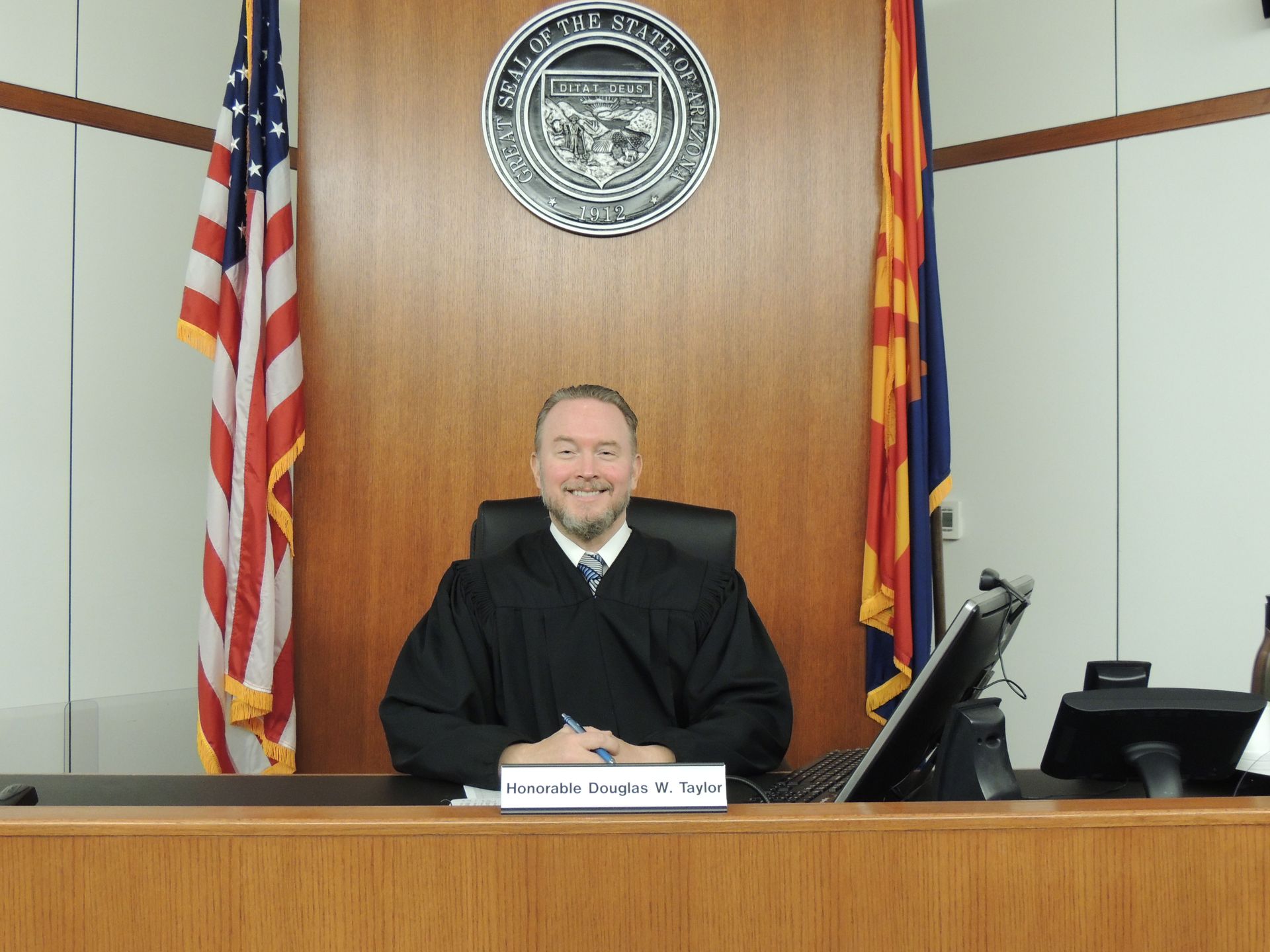
Douglas W. Taylor, Sr. is a former Pima County judge who presided over domestic-violence matters and now defends people accused of criminal offenses. He reviews the evidence, the legal standards, and the circumstances surrounding the incident to assess the issues in each case.
Call Taylor Law Group, PLLC at (520) 440-5635 for a free and confidential consultation.
Search our site
Categories
FOLLOW US