

Fact-Checked
This page has been written, edited, and reviewed by our owner, Doug Taylor, who has 25+ years of legal experience as a former Pima County judge and elected official, and a criminal and DV defense and restraining order lawyer. Our last modified date shows when this page was last reviewed.
What Happens When a Child Is Present During a Domestic Violence Incident in Arizona?
- A child’s presence during a domestic violence incident can prompt a safety check and affect related proceedings. But, it does not automatically create a separate charge or decide a custody case. Here’s how Arizona law treats the situation...
What Happens When a Child Is Present During a Domestic Violence Incident in Arizona?
When police respond to a domestic violence call and a child is present, they must consider the child’s safety. That can lead to questions about what the child saw or heard, whether the child may have been affected, and whether additional investigation is needed.
But a child’s presence does not automatically prove that either adult committed a crime, turn a misdemeanor into a felony, or establish a separate child-abuse charge. The legal consequences depend on the alleged conduct, the evidence, and the proceedings involved.
What must police do if a child is present?
Under A.R.S. § 13-3601N, an officer responding to a call alleging domestic violence must determine whether a minor is present. If one is, the officer must conduct a child-welfare check to determine whether the child is safe and might be a victim of domestic violence or child abuse. A welfare check is an assessment; it does not itself establish that a crime occurred.
Officers may ask who was present, where the child was, what the child may have observed, and whether the child appears to need assistance. They may document their observations and statements in reports. What happens next depends on the circumstances and the information gathered.
Does a child’s presence change the criminal charge?
The domestic violence designation generally depends on the underlying alleged offense and whether the relationship meets Arizona’s statutory requirements. The child’s presence alone does not create the domestic violence designation.
For a felony, Arizona’s sentencing law lists committing an offense in a child’s presence, in circumstances covered by the domestic violence statute, as a possible aggravating factor. It is not an automatic increase in the charge or sentence. Its application depends on the offense, the evidence, and the required findings under the sentencing law.
For felony sentencing, A.R.S. § 13-701(D)(18) lists committing an offense in a child’s presence, when the circumstances described in A.R.S. § 13-3601(A) apply, as a possible aggravating circumstance. It does not automatically increase the charge or sentence.
Could there be a separate child-abuse or endangerment charge?
Possibly, if the facts support the elements of a separate offense. Arizona’s child-abuse statute addresses conduct that causes or permits injury or places a child in an endangered situation. The charge and classification depend on the circumstances and the alleged mental state.
A child being somewhere in the home during an argument does not, by itself, establish those elements. Investigators and prosecutors may examine the specific conduct, the child’s proximity to any danger, any injury or other evidence, and the reliability of the available accounts. A.R.S. § 13-3623
Can an Order of Protection affect contact with a child?
Yes, depending on the order. Under A.R.S. § 13-3602, an Order of Protection may prohibit contact with the person who requested protection or other specifically designated people. It may also give one party exclusive use of a shared residence. If a child is covered by the order, it may restrict contact with that child.
A criminal release order may also impose pretrial conditions to protect the alleged victim and other designated people under A.R.S. § 13-3601(I). Read and follow every order carefully. A knowing violation of an Order of Protection may lead to arrest and a separate charge of interfering with judicial proceedings under A.R.S. §§ 13-3602(R) and 13-2810. Don’t assume a parenting-time arrangement permits contact that another order prohibits.
How can the incident affect a family-court case?
A criminal case and a family-court case are separate proceedings. In a legal decision-making or parenting-time case, Arizona law directs the court to consider domestic violence and the child’s best interests.
If the family court determines that a parent committed domestic violence, the law creates a rebuttable presumption that awarding that parent legal decision-making or parenting time is contrary to the child’s best interests.
The child does not necessarily have to have witnessed the incident for that family-court presumption to apply. Arizona law says the child’s absence from the scene or lack of awareness does not defeat it. The court considers the evidence and circumstances under the rules that apply in that proceeding. A.R.S. §§ 25-403 and 25-403.03(C), (D), and (F).
What evidence may matter?
The complete record can be important in both criminal and family-court proceedings.
Depending on the case, relevant evidence may include:
- 911 recordings and dispatch records
- Body-camera or other video footage
- Statements from adults and other witnesses
- The location of each person, including the child
- Text messages or other communications before and after the incident
- Evidence that supports or contradicts claims about injury, threats, or self-defense
- The exact wording of any release conditions or court orders
Accounts made during a stressful incident may be incomplete or inconsistent. The evidence should be reviewed in context, including what was recorded and what may not have been investigated.
What should a parent do after an arrest or accusation?
- Follow every release condition and court order carefully.
- Do not contact someone if an order prohibits contact, and do not ask a child to change, rehearse, or repeat a particular account.
- Preserve potentially relevant messages, photos, recordings, and other evidence.
- If criminal charges and a family-court case are both involved, get advice about how the two proceedings and their orders affect one another.
A former judge’s perspective
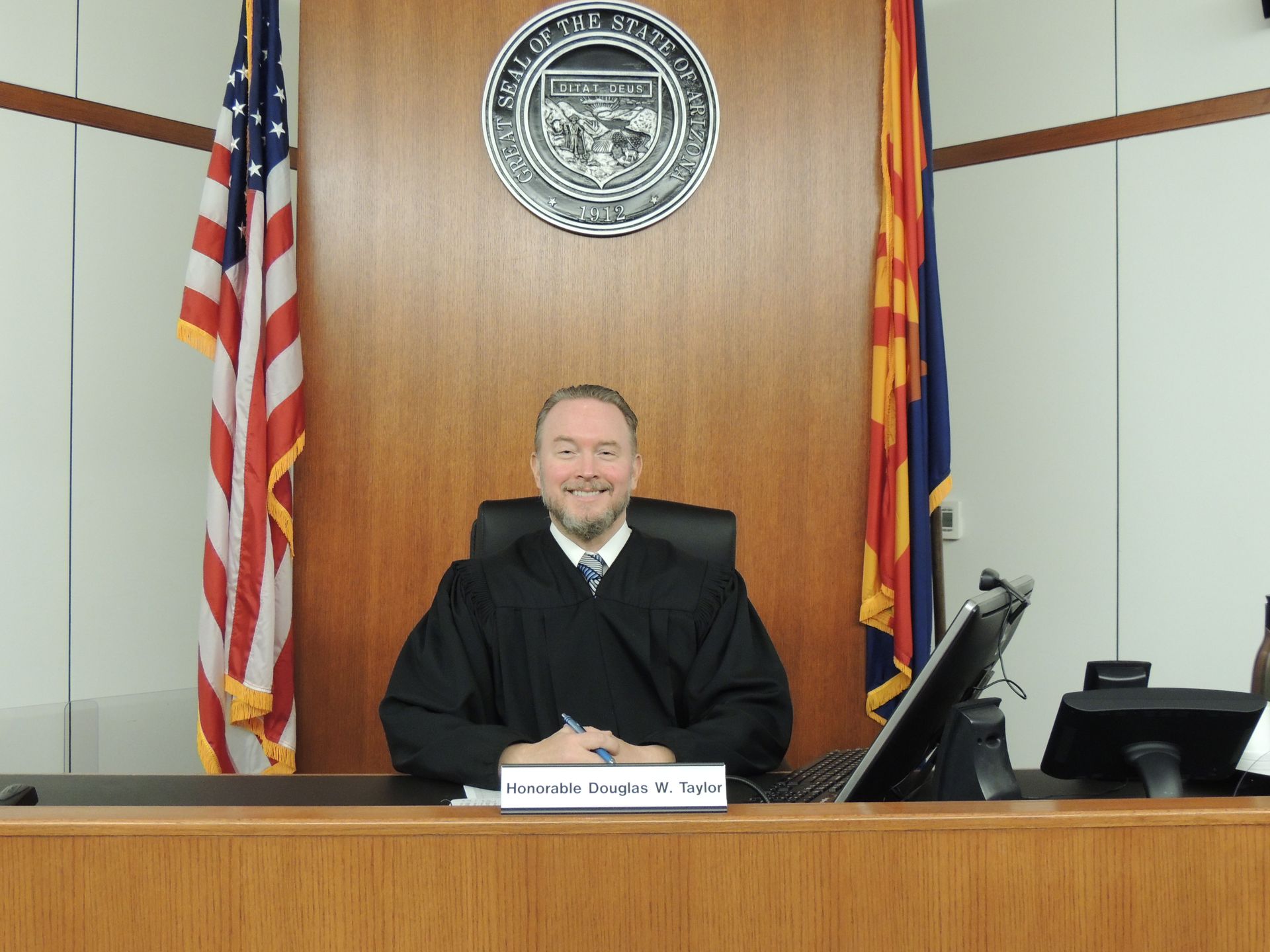
Douglas W. Taylor, Sr. is a former Pima County judge who presided over domestic violence matters and now defends people accused of criminal offenses. His courtroom experience informs how he evaluates reports, witness accounts, evidence, and the issues a criminal court may need to resolve.
Frequently asked questions
Does a child’s presence automatically make a domestic violence charge a felony?
No. The underlying offense determines its classification. A child’s presence may be considered as a possible aggravating factor in certain felony sentencing circumstances, but it does not automatically make a charge a felony.
Will police automatically remove a child from the home?
Not solely because a child was present. Officers must conduct a child-welfare check when the statute applies. Any further action depends on the circumstances and the child’s safety.
Can family court address domestic violence without a criminal conviction?
Family court applies its own rules and evidentiary standard. Arizona law provides for a domestic-violence determination in parenting-time and legal decision-making proceedings based on a preponderance of the evidence.
Does the child have to witness the incident for it to affect parenting time?
Not necessarily. Arizona law says a child’s absence from the scene or lack of awareness does not, by itself, prevent the statutory presumption from applying after the court determines that a parent committed domestic violence.
Can an Order of Protection restrict contact with my child?
It can, depending on who is specifically designated in the order and what its terms say. Read the order carefully and get legal advice before attempting contact.
Speak with a Tucson domestic violence defense attorney
A domestic violence allegation can affect a criminal case, family relationships, and court-ordered contact. Douglas W. Taylor, Sr. represents people facing domestic violence allegations in Tucson and Southern Arizona.
Call Taylor Law Group, PLLC at (520) 440-5635 for a free and confidential consultation.
Search our site
Categories
FOLLOW US